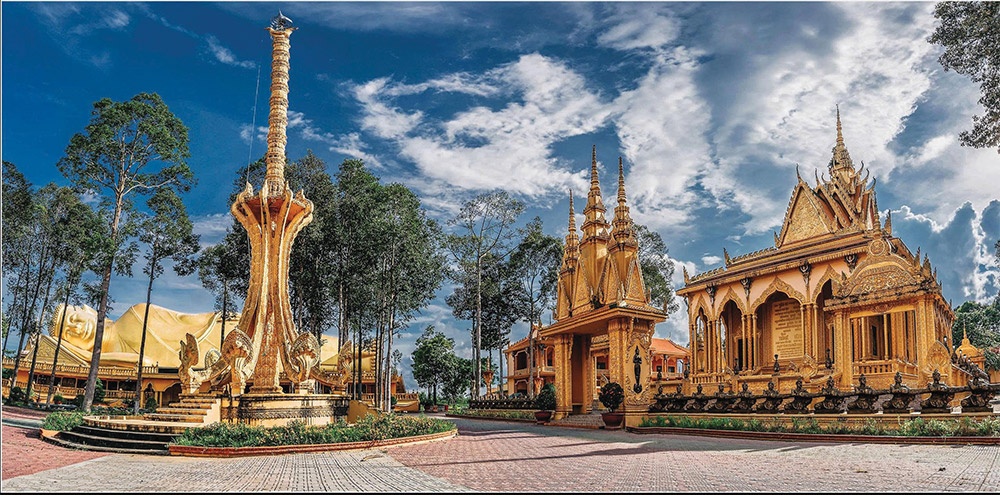
Tra Vinh, now part of Vinh Long, gains tourism momentum as fresh driver
Several key sites in the locality have developed community and experiential tourism models

Recognising tourism as an integrated service economy rich in cultural and humanistic values and a key driver for national development, the tourism industry of the Tra Vinh area is undergoing a steady transformation, contributing positively to the local economy.

According to the former Tra Vinh Department of Culture, Sports and Tourism (DCST), the first half of 2025 saw encouraging progress in it tourism industry. Total tourism revenue reached $54.05 million, equal to 51 per cent of the full-year plan.

The total number of tourist arrivals surpassed 2.32 million, equal to 54 per cent of the full-year target, of whom international visitors approximated 84,500, reaching 80 per cent of the full-year target.

Local tourist accommodations hosted more than 664,600 guests, with about 77,600 international arrivals, representing 55 and 85 per cent of full-year targets, respectively. Average room occupancy climbed to 69 per cent, up 3 per cent on-year. This was deemed a solid achievement given the broader economic challenges that have partially impacted local tourism.

Currently, the locality boasts 138 tourism accommodation establishments, including three guesthouses, 23 hotels, 10 homestays, and over 100 standard facilities.

In addition, it is home to more than 30 restaurants that offer regional specialities, souvenirs, food services, and entertainment; two international travel agencies; and 14 domestic travel companies.

Efforts to promote tourism, streamline administrative procedures, support businesses, and embrace digital transformation are regularly prioritised by the locality. These have laid the groundwork for the tourism industry’s steady growth, resulting in distinctive offerings that entice more visitors.

The former Tra Vinh is home to seven prominent tourism sites recognised by the Mekong Delta Tourism Association: the Ho Chi Minh Temple historical site, Con Chim community tourism site, Huynh Kha ecotourism site, Ao Ba Om cultural and tourism area, Con Ho community ecotourism site, Khmer ethnic culture museum, and the memorial site of national heroine Nguyen Thi Ut.

It also features over 140 Khmer Theravada Buddhist pagodas, distinguished by their unique architecture and rich cultural heritage.

Numerous traditional festivals of ethnic minority communities are celebrated throughout the year. Additionally, it boasts two national treasures, eight intangible cultural heritage titles, 16 national relics, and 44 provincial-level relics.

At the ASEAN Tourism Forum 2025 held in Malaysia, the Con Chim site received the ASEAN Community-Based Tourism Award, spotlighting Tra Vinh’s success in community-based tourism.

This international recognition provides an excellent opportunity to introduce more locally distinct destinations to domestic and international travellers.

The Con Chim site, surrounded by the Co Chien River, dense nipa palm forests, and lush mangroves, spans 62 hectares and is home to over 200 residents. It is one of several key sites to have developed community and experiential tourism models, combining ecological protection with cultural preservation.

The Khmer Cultural and Tourism Village was also launched in the area, closely linked to the scenic Ao Ba Om area and the Bo Luy-Lo Gach pagoda archaeological site.

Other notable destinations include Con Ho islet in Cang Long area and Tan Quy islet in Cau Ke area, known for their preserved southern rural culture, clean agriculture, fresh air, and year-round tropical fruits.

Local management is focusing resources on developing infrastructure to better connect local tourism sites and integrate with other destinations across the Mekong Delta. It is also investing in coastal corridor roads to promote the local marine economy in tandem with tourism development, while forming land reserves to attract strategic investors to build high-end resorts in the green tourism city of Tra Vinh and the coastal tourism town of Duyen Hai.

According to Duong Hoang Sum, director of the DSCT, this year the locality aims to welcome 4.2 million visitors, including nearly 80,000 international tourists, and record 1.2 million overnight stays. The tourism industry aims to generate approximately $107.2 million in total revenue, showing a 5 per cent jump on-year.

“By 2030, Tra Vinh, now as part of Vinh Long, seeks to establish tourism as a key economic sector, contributing to propelling socioeconomic development, upgrading tourism infrastructure, and offering high-quality, culturally rich tourism products with a strong national identity,” Sum said. “These efforts will also ensure our capacity to host regional and national-scale cultural, sports, and tourism events.”

Tra Vinh efficient in propelling public investment Tra Vinh takes on high-tech agriculture Tra Vinh adds to its regional rank scores Tra Vinh gains momentum as regional economic bright spot Tra Vinh province makes major gains in PCI rankings

Highlighting the Japanese company’s rare 80-year investment history in Vietnam, PM Chinh stated that Marubeni’s effective operations have significantly contributed to Vietnam’s socio-economic growth.

Prime Minister Pham Minh Chinh urged Japanese conglomerate Marubeni Corporation to deepen its strategic investments in Vietnam, positioning the country as a key base for its “long-term vision and large-scale implementation”, according to a report from the Government News.

During a meeting in Hanoi on July 14, PM Chinh assured Marubeni CEO Masayuki Omoto that legal obstacles for major energy projects, including the O Mon II gas-fired power plant, have been resolved and that a feasible legal framework is now in place for LNG and offshore wind investments.

The PM encouraged Marubeni to expand its footprint in high-priority sectors, especially energy. He called for investment in gas-fired and offshore wind power projects to fuel GDP growth, support the development of artificial intelligence and big data infrastructure, and facilitate electricity exports to ASEAN nations.

Further areas for collaboration proposed by the PM included: partnering with Vinacomin to export coal to Japan; developing crop varieties and livestock, and building brands for exporting key Vietnamese products like coffee, rice, and high-quality foods; and investing in industrial parks and establishing factories for products such as instant noodles, mochi cakes, and pharmaceuticals for both domestic and export markets.

PM Chinh also called on Marubeni to help integrate Vietnamese businesses into its global supply chains and to support human resource training, scientific cooperation, and digital transformation.

In response, CEO Masayuki Omoto lauded Vietnam’s strategic policy-making and its improving business environment, noting that government reforms to streamline the state apparatus would enhance efficiency and shorten licensing and decision-making timelines for investors.

Emphasizing that Vietnam is a “very important strategic market”, Mr. Omoto reaffirmed Marubeni’s commitment to the country’s development. He announced that the corporation plans a major expansion with high-quality investments focused on human resource training. These ambitious plans include the O Mon II and Quang Ninh LNG power projects, wind and solar farms, the Amata City Ha Long Industrial Park, new processing factories for export, and smart city developments in Hanoi and Ho Chi Minh City.

Highlighting the company’s rare 80-year investment history in Vietnam, PM Chinh stated that Marubeni’s effective operations have significantly contributed to Vietnam’s socio-economic growth. He concluded by reaffirming that the Vietnamese Government will always create favorable conditions for foreign investors, operating in the spirit of “harmonized benefits, shared risks”.

Marubeni’s office in Vietnam was established in 1991. The corporation’s projects in Vietnam currently employ around 7,500 Vietnamese staff and generate a total annual revenue of about $3 billion.

The project will supply 1,520 units.

The Construction Department of the central province of Ha Tinh is calling for investors to build a social housing project with an estimated investment capital of over VND2.38 trillion ($90.49 million).

The project will cover around 6.2 ha in the province’s Tran Phu ward.

It will consist of five 15-storey social buildings with around 1,520 units and one 15-storey commercial building with 273 units.

The project will provide houses for over 7,000 people, mainly low-income earners and workers.

Construction of the project is part of the province’s plan to implement the Government program on developing 1 million social houses for low-income owners and workers at industrial parks.

The province targets to complete 3,700 social houses by 2030. Of which, 1,500 social houses are expected for completion in the 2021-2025 period.


HONG KONG SAR – Media OutReach Newswire – 14 July 2025 – Cushman & Wakefield, a leading global real estate services firm, has won the Gold Prize in the Integrated Marketing category at the 11th Phoenix Tree Digital Marketing Summit 2025 and Awards Ceremony for the firm’s Better Never Settles brand campaign. The firm also won the Silver Prize in the ESG Marketing categoryforits Earth Day campaign; and the Bronze Prize in the Video Marketing category for its Better Never Settles video series.
Cushman & Wakefield launched the Better Never Settles brand campaign in Greater China in June 2024. The firm conducted marketing activities both internally and externally through a range of channels including online social platforms and offline in-person events, significantly enhancing brand impact, demonstrating a market-leading position and marking an important milestone for the branding campaign globally.
Cushman & Wakefield Greater China launched a one-month Earth Day — Planet vs Plasticscampaign, running from April 22 to May 22, in conjunction with Bottloop, a pioneer in recycling and environmental conservation. Staff across more than 20 offices actively engaged in the campaign, which was widely featured through a range of channels including WeChat, Weibo and leading media outlets, achieving more than 90,000 views and demonstrating a successful ESG marketing initiative.
The firm’s Better Never Settles video series has been one of the most notable Better Never Settles campaign elements. The short-format video series showcased four team members from different markets and different business units sharing their stories on how they bring “Better never settles” into their lives when they engage in sports, arts, career development and in their personal lives. The video series reached over 140,000 views, generating significant buzz in the industry and reinforcing the firm’s strong branding.
KK Chiu, Chief Executive, Greater China, Cushman & Wakefield, said, “We are honored to receive such high recognition for our excellent performance at the 11th Phoenix Tree Marketing Awards. This achievement reflects the trust and respect from our clients, media and the real estate community, and marks an important milestone in the growth of our marketing capabilities across Greater China. We will continue to deliver innovative and integrated marketing initiatives to strengthen our brand positioning and elevate our industry presence because at Cushman & Wakefield, better never settles.”
Founded in 2015 at the inaugural WMMS Global Mobile Marketing Summit, the Phoenix Tree Awards form part of the industry’s premier recognition for mobile marketing excellence. Judged by an independent panel of senior experts, the awards evaluate criteria including innovation, strategy, execution and impact, celebrating companies that set new standards in brand marketing. Over the years, they have evolved into a symbol of professionalism and prestige, renowned for honoring high-quality case studies that drive industry advancement.

The issuer is solely responsible for the content of this announcement.

The Government leader directs urgent and high-quality development of infrastructure for the 2027 APEC Leaders’ Week in Phu Quoc Island.

Prime Minister Pham Minh Chinh asked relevant ministries, agencies and localities in the Mekong Delta region to further accelerate key transport infrastructure projects, while chairing a conference held in Can Tho city on July 13.

The conference focused on the operation of the two-tier local government model, the progress of key transport infrastructure projects, and the implementation of the Mekong Delta’s sustainable one-million-hectare low-emission and high-quality rice cultivation plan.

He directed an all-out approach, with the entire political system involved and local leaders regularly inspecting progress. All obstacles must be proactively removed, and local subcontractors should be engaged to help develop regional businesses, according to the PM.

PM Chinh also directed the urgent and high-quality development of infrastructure for the 2027 APEC Leaders’ Week in Phu Quoc island, including waste treatment, clean water supply, wastewater systems, transport links, green spaces and lighting, serving both immediate needs and long-term development.
Regarding the two-tier government model, he praised the sound implementation in the region, while stressing the need for more synchronized and professional operations.

On the low-emissions rice initiative, he emphasized its global significance as the first low-emission, high-quality rice-specialized region in the world, helping to ensure domestic and international food security, combat climate change, promote sci-tech research and application,  innovation, digital transformation, regional and global value chain integration, and elevate Vietnam’s rice and national brand.

The proposed investment is appropriate and adheres to the developmental roadmap laid out in the master plans for the period to 2030 and beyond.

The Ministry of Construction (MoC) has issued an Official Dispatch to the Ministry of Finance, requesting its opinion on the investment policy approval dossier for the Cai Mep Ha General and Container Port construction project.

Accordingly, the MoC affirmed that the project proposal—submitted by a consortium of investors including Geleximco Group, International Transport and Trading Joint Stock Company (ITC), and the State Capital Investment Corporation (SCIC)—is in line with both national and sectoral development strategies.

Specifically, the proposal aligns with the National Overall Master Plan for the 2021-2030 period, with a vision toward 2050, the master plan  for the Development of Vietnam’s Seaport System, and the detailed planning for the regional seaport cluster for the 2021–2030 period, with a vision toward 2050. This alignment encompasses the project’s investment objectives, the proposed vessel capacity, and the number and functionality of its berths.

The MoC also noted that the proposed phasing of investment is appropriate and adheres to the developmental roadmap laid out in the master plan for the period to 2030 and beyond.

According to the ministry, the project will not only help realize the goal of transforming the Ba Ria–Vung Tau seaport into an international gateway but also address persistent challenges stemming from previously fragmented and small-scale investments.

Currently, the Ba Ria–Vung Tau seaport area has seven container berths with a designed annual capacity of approximately 7.66 million TEUs (as of 2020). However, over the past three years, actual throughput has consistently exceeded this figure, averaging more than 8 million TEUs annually. In 2024 alone, throughput reached 10.98 million TEUs, with the majority handled by five berths within the Cai Mep terminal area.

Under the Master Plan for National Seaport System Development for the 2021–2030 period, with a vision to 2050, the Cai Mep–Thi Vai terminal area has been identified as a priority investment zone. The implementation roadmap for this master plan further emphasizes the need for the swift selection of an investor to advance development in the Cai Mep Ha area, consistent with approved planning.

The proposal calls for the expansion of 18 component projects along the expressway, a vital artery for the nation’s economy.

The Ministry of Construction has submitted a report to Prime Minister Pham Minh Chinh and Deputy Prime Minister Tran Hong Ha, proposing for expanding key sections of the Eastern North-South Expressway under Public-Private Partnership (PPP) model. 

The proposal calls for the expansion of 18 component projects along the expressway, a vital artery for the nation’s economy.

This work is part of a national goal to complete 3,000 km of expressways by 2025 and is considered essential to support ambitious economic targets, including 8% GDP growth or highter in 2025 and annual double-digit growth in the 2026-2030 period.

While the ministry had initially recommended using public funds to allow for immediate implementation and avoid project delays, Government leaders have now directed the ministry to study the feasibility of leveraging private investment through the PPP method.

Upon completion of all component projects, toll collection will be implemented on all sections, including those built with public funds, in accordance with National Assembly resolutions.

To ensure seamless and efficient operation across the entire route, the Ministry plans to select investors using a combined approach. The strategy will prioritize a blend of Operate & Manage (O&M) and Build-Operate-Transfer (BOT) models.

Under an O&M contract, the state funds the investment and hires a private firm to operate and maintain the project. In contrast, the BOT model allows a private investor to directly fund construction and operate the road for a specific period to recoup their investment capital before transferring it back to the State.

Electronics remains a pillar, accounting for 57% of the country’s total export turnover.

Electronics remains a pillar of Vietnam’s export economy, representing approximately 57% of total export turnover, according to the latest report on “Electronics FDI Sector Ahead of Reciprocal Tariffs’ Effects” released by FiinRatings.

Electronics sector encompasses key product categories such as computers; electronic products and components; mobile phones and parts; cameras, camcorders, and accessories; machinery and spare parts; as well as electrical wires and cables.

The top 48 FDIs in the field of electronics are responsible for around 70% of the country’s electronics export turnover, in which Samsung-related entities contributing 30%, followed by Apple’s supplier network with 9%.

The report also suggests opportunity to reshape Vietnam’s electronics supply chain, which currently reveals a substantial reliance on imports, with less than 1% of input value sourced from domestic suppliers, while 15% from FDI satellite firms, and the remainder fully imported. 


Vietnam’s target of high and sustainable growth to take it to the ranks of high-income countries demands the right policy vision from the outset.

Vietnam has set out an ambitious development roadmap, aiming for GDP growth of 8 per cent in 2025 and moving towards double-digit growth during the 2026-2030 period. Looking even further ahead, the country envisions joining the group of upper-middle-income economies by 2030 and ascending to the ranks of high-income nations by 2045. These are not merely growth estimates; they vividly reflect a strong aspiration to rise, showcasing a strategic vision, effective governance, and consistency in macro-economic policy management.

To realize these high and sustainable economic growth targets, Vietnam will need to adopt a development mindset that is flexible, innovative, and breakthrough-oriented.

Three scenarios

According to analysis by a research team from the National Economics University (NEU), there are three potential economic growth scenarios for Vietnam to 2045. Each represents a distinct development pathway, with varying levels of risk and corresponding policy requirements for the country to achieve high economic growth.

The first scenario – Scenario A – follows a “Fast Start” model, designed to generate a significant boost in the early stages to rapidly scale up the size and position of the national economy. Vietnam’s GDP is projected to grow at an average annual rate of 11 per cent from 2025 to 2029, then taper off to 9 per cent annually between 2030 and 2037, and finally stabilize at 7-8 per cent annually from 2038 to 2045. However, experts caution that this model carries the risk of overload in the initial years, which could lead to “burnout” if not supported by flexible adjustments and substantial resources.

The second scenario – Scenario B – adopts a “Prolonged Acceleration” model. This path maintains a high growth rate of 11 per cent annually for a longer period (2025-2031), then gradually decreases to 8.5-9 per cent (2032-2038) and 6.5-7.5 per cent (2039-2045). Economists note that this approach helps distribute growth pressure more evenly over time, allowing better policy and investment preparation. However, it faces the challenge of sustaining strong and stable growth momentum over an extended period.

The third scenario – Scenario C – follows a “Growth Wave” model. Vietnam’s economic growth is segmented into clearly defined “phases”: 2025-2030 is a preparatory phase, with growth of 8-10 per cent annually; 2031-2035 is an acceleration phase, reaching 11-12 per cent; followed by 8.5-9 per cent during 2036-2040; and, finally, 6.5-7.5 per cent from 2041-2045. Many experts consider this scenario the most feasible, as its growth pace aligns with natural development cycles and reduces the risk of “growth shocks”.

Notably, under Scenario C, Professor Tran Thi Van Hoa from the NEU believes the goals outlined are entirely achievable provided that Vietnam rigorously implements institutional reforms, comprehensively invests in strategic infrastructure, enhances workforce quality, and accelerates the application of advanced technologies across all economic sectors. If these conditions are fully met, Vietnam could reach per capita income of $28,370 by 2045, marking its transition into the group of high-income countries.

Strategic pathways

Vietnam achieving its ambitious economic growth targets will not be without challenges. In addition to internal issues such as workplace productivity, institutional quality, and business competitiveness, the country is also facing significant external pressures from global shifts, including geopolitical tensions, policy changes by major economies, global supply chain disruptions, and growing demands for green development, digital transformation, and energy security.

To navigate these challenges, Vietnam must adopt a development strategy that is both flexible and long-term. Relying on outdated growth models based on resource exploitation, cheap labor, and excessive public investment is no longer viable.

Professor Hoa argues that an economy aiming for high-income status must move away from traditional paths. The key lies in deep reforms to both institutions and development policies. Regarding institutions, it is essential to streamline organizational structures, ensure transparency in responsibilities, and enhance the legal framework to support the digital economy, innovation, and emerging business models. Flexible experimental mechanisms, such as industry-specific sandboxes, should also be implemented to suit local conditions.

Additionally, FDI needs to be more selective, focusing on high-tech sectors and ensuring technology transfer, workforce training, and partnerships with domestic enterprises to upgrade local value chains. Investing in digital infrastructure, particularly advanced technologies like AI, the Internet of Things (IoT), and big data, should be a strategic priority to drive breakthroughs in productivity and efficiency. “These are the core factors that will help Vietnam break through, not only in growth speed but also in the quality and sustainability of long-term development,” Professor Hoa said.

Dr. Dang Thi Thu Hoai, from the Institute for Policy and Strategy Studies, believes that although innovation has contributed to Vietnam’s economy in recent years, its overall effectiveness is still not clearly visible. To improve the quality of its growth, Vietnam needs to implement a synchronized set of key solutions. The first focus should be on boosting productivity in the private sector, which plays a central role in the economy. The second focus should be improving intra-sector productivity. Lastly, enhancing regional connectivity and investing in infrastructure are fundamental. “Investing in infrastructure and reorganizing provincial administrative units will optimize resource allocation and create a more efficient, sustainable growth model,” Dr. Hoai said.

Investment focus on key areas

Adding another perspective on policies for achieving high and sustainable economic growth in the years ahead, Dr. Nguyen Bich Lam, former Director General of the General Statistics Office (now the National Statistics Office at the Ministry of Finance), emphasized that effectively utilizing public investment resources is crucial for the economy’s recovery and long-term development.

While accelerating public investment in infrastructure is essential, this alone is not enough to ensure sustained growth. Without close integration with policies that support production and enhance domestic business capacity, public investment’s spillover effects will be limited, and maintaining high growth will be challenging.

Moreover, if public investment is scattered and lacks strategic focus, its effectiveness will be low, leading to wasted resources. Dr. Lam believes Vietnam must prioritize areas such as integrated logistics infrastructure, digital transformation in both the public and private sectors, clean energy development, and the growth of manufacturing. These are key for public investment to drive sustainable growth in the years ahead.

Improving workplace productivity is critical for long-term growth, but relying solely on human labor is insufficient.

Associate Professor Pham The Anh from the NEU suggested that Vietnam could learn from the successful strategies of rapidly-developing economies like Japan, South Korea, Singapore, and China. These countries focused on key industries, supported by strong policies in taxation, credit, and business reforms.

Additionally, these nations have a flexible approach to macro-economic management, effectively controlling inflation, maintaining fiscal discipline, stabilizing exchange rates, and restructuring their economies to adapt to global shifts. They also attract FDI to promote industrialization and expand exports. Infrastructure investment remains a foundation for long-term competitive advantage. “Vietnam can apply these international lessons by creating a structured industrial development strategy, focusing on key sectors, and ensuring a consistent and cohesive policy system,” Associate Professor Anh concluded. “This will be key to breaking through in growth, achieving high rates while ensuring quality and sustainability in the future.”


“Strengthening public investment in infrastructure is the right move, but it’s not enough. Without accompanying investments in production development and support for businesses, sustaining growth momentum will be difficult.”

Dr. Nguyen Bich Lam, former Director General of the General Statistics Office (now the National Statistics Office at the Ministry of Finance)


“An economy aiming for high-income status must move away from traditional paths. The key lies in deep reforms to both institutions and development policies.”

Professor Tran Thi Van Hoa from the National Economics University (NEU)


The project has total investment capital of $193 million with a capacity of 120 million ceramic products annually.

Authorities of the central province of Thanh Hoa have granted investment certificate for Lares Pte. Ltd of Singapore to build an ASEAN Vietnam Ceramic Valley project at Van Thang Yen Tho Industrial Cluster.

The project will cover over 322,345 sq.m in Nong Cong and Yen Tho communes.

The project has estimated investment capital of more than VND5.1 trillion ($193 million) and a capacity of producing 120 million ceramic products per year, including household and industrial ceramics.  

The project implementation will be divided into three phases. The first is scheduled for completion in the second quarter of 2027 with an estimated investment capital of over $84.6 million, while the second is expected to be completed in the third quarter of 2028 with an estimated investment capital of more than $100.1 million. The third is planned for completion in the second quarter of 2030 with investment capital of around $4.3 million.

The investor will contribute over VND1.02 trillion ($38.7 million), while the rest will be mobilized from different legal sources.
