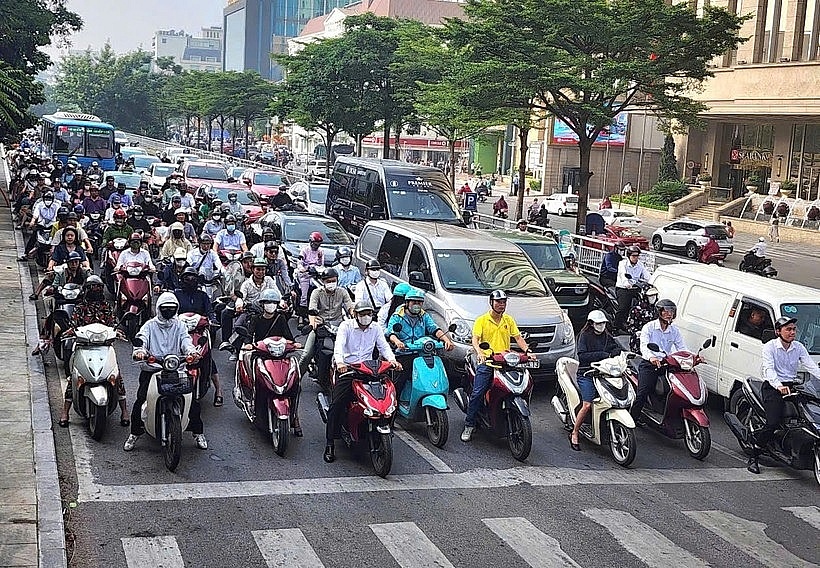
From July 1, a flat 2 per cent registration fee for new motorcycles has come into effect nationwide, replacing the previous 5 per cent rate that applied in major urban centres such as Hanoi and Ho Chi Minh City.

Vehicle fee structure aims for fairness for localities
Vehicle fee structure aims for fairness for localities, illustration photo/VNA

The policy aims to harmonise tax obligations across regions and create more equitable conditions for vehicle ownership.

The reduction offers significant cost savings for consumers. A standard Honda Lead scooter, priced at VND40 million (around $1,600), previously incurred a registration fee of $80 in big cities. Under the new policy, the fee drops to just $32.

For high-end models like the Honda Gold Wing, which retails at around $49,200, the fee is reduced from $2,450 to $980. Even entry-level models such as the Wave Alpha 110, priced at around $710, now carries a fee of $14, down from over $35.

Used motorcycles remain subject to a 1 per cent registration fee from the second transaction onward, consistent with previous regulations.

According to the Ministry of Finance (MoF), the move responds to recent administrative restructuring, which involved merging communes and districts nationwide.

“The unified fee structure ensures fairness for residents in newly consolidated localities, preventing them from being subject to higher rates based on their previous administrative designation,” the MoF noted in its statement.

Importantly, the decree also decentralises the authority to issue vehicle valuation tables from the MoF to provincial people’s committees. This measure is designed to enhance administrative efficiency and allow local governments to adapt more responsively to market conditions and regional dynamics.

The revised fee schedule also includes other vehicle types. Four-wheeled electric buggies used in golf courses and resorts, as well as specialised utility vehicles, are now subject to a 2 per cent fee. Passenger pickup trucks face a 10 per cent rate, similar to regular passenger cars.

Double-cabin pickups and cargo vans with two or more rows of seats and a fixed partition separating passenger and cargo areas will be taxed at 60 per cent of the standard car registration fee.

Industry stakeholders seem to have responded positively. “This is a practical, demand-driven policy that lowers the upfront barrier for consumers,” said Nguyen Van Hieu, sales director at a Hanoi-based motorcycle dealership. “We expect to see stronger purchasing activity from July onwards, especially among first-time buyers and customers who had previously delayed purchases due to high fees.”

Vietnam’s motorcycle market, which had endured a downturn during 2022–2023, has shown clear signs of recovery in 2025. According to industry estimates, over 1.32 million units were sold nationwide as of the end of May, marking a more than 20 per cent increase on-year. The growth is particularly robust in the electric scooter segment, where affordability, fuel savings, and ease of use continue to draw in younger urban consumers.

Tax experts also view the reform as a positive development in Vietnam’s broader fiscal restructuring.

“By simplifying the registration fee system and empowering local authorities, the government is easing the burden on both taxpayers and tax administrators,” said Tran Thi Hoai An, an independent tax researcher based in Ho Chi Minh City. “This aligns with ongoing efforts to decentralise public finance and make tax policies more adaptive.”

The call came during the Prime Minister’s meeting with Mr. Gerald Toledano, FTSE Russell’s Global Head of Equity and Multi-Asset, who is leading a delegation to assess Vietnam’s capital markets for a potential reclassification.

Prime Minister Pham Minh Chinh has urged global index provider FTSE Russell to accelerate its support for Vietnam’s bid to achieve emerging market status, stressing the need for a transparent and stable market to drive capital mobilization.

The call came during the Prime Minister’s meeting in Hanoi on July 17 with Mr. Gerald Toledano, FTSE Russell’s Global Head of Equity and Multi-Asset, who is leading a delegation to assess Vietnam’s capital markets for a potential reclassification, according to a report from the Government News.

The Prime Minister specifically requested FTSE Russell’s advisory support on strengthening the legal framework, modernizing infrastructure, implementing smart governance, and developing a high-caliber workforce. He also asked for assistance in attracting global capital flows and realizing Vietnam’s ambition to establish an international financial center.

In response, Mr. Toledano affirmed FTSE Russell’s firm commitment to supporting Vietnam’s push to upgrade its stock market from “frontier” to “emerging”. He pledged to partner with the nation on its long-term development goals, including its Vision to 2045 for economic prosperity, and committed to actively sharing information about Vietnam’s reforms and progress with the global investment community.

Mr. Toledano highlighted the impressive results of Vietnam’s market development, noting its stock market now boasts the highest liquidity in the ASEAN region, surpassing both Thailand and Singapore.

He praised Vietnam’s determination and credited critical reforms—such as developing a roadmap for a Central Counterparty (CCP) mechanism—as key factors positioning the economy for sustainable growth and supporting its case for reclassification.


Vietnam has rolled out many efforts to soon meet upgrading requirements.

With Vietnam’s reform determination together with support from international organizations, its stock market will soon meet requirements for upgrading and becoming an attractive destination in the region,  Minister of Finance Nguyen Van Thang told Gerald Toledano, Global Head of Equity and Multi Asset of FTSE Russell, a member of the London Stock Exchange Group, during their working session in Hanoi on July 17.

Mr. Thang outlined Vietnam’s ongoing reforms, noting that the Ministry of Finance has directed the State Securities Commission of Vietnam (SSC) to engage regularly with international market rating agencies and investors to share updates on Vietnam’s stock market reforms and gather feedback.

The ministry is finalizing a draft decree amending the Government’s Decree No. 155/2020/ND-CP to enhance transparency in foreign ownership limits and eliminate outdated rules, such as those allowing shareholder meetings to set maximum foreign ownership levels, he said.

Regarding administrative procedures relating to investment activities of foreign investors, the ministry has coordinated with the State Bank of Vietnam (SBV) to simplify procedures and cut processing time, according to the minister.

On the foreign exchange market, he said the ministry is working with the SBV to develop a legal framework for hedging instruments to address exchange rate risks.

Concerning the central counterparty (CCP) clearing mechanism, Vietnam has recently launched KRX system, laying technical groundwork for the launch of the CCP in early 2027.

For his part, Mr. Toledano affirmed that FTSE Russell stands ready to help Vietnam upgrade its capital market infrastructure to attract stronger inflows of foreign investment. It will also help the SBV develop indices that help investors better manage financial risks.

The Presidential Office held a press conference on July 11 to announce laws adopted at the ninth session of the National Assembly’s 15th Legislature, which concluded on June 28.

Among them were the Law on Special Consumption Tax, Law on Management and Investment of State Capital in Enterprises, Law on the State Budget, and the Law on Corporate Income Tax.

At the event, Deputy Minister of Finance Le Tan Can presented the key changes and implications of each law.

He noted that the Law on the State Budget was developed in close alignment with the resolutions and conclusions of the Party Central Committee and the Politburo.

It supports institutional restructuring, the implementation of a two-tier local government model, and the promotion of science, technology, innovation, and national digital transformation.

Key financial laws aim to drive institutional reform and growth
Tax incentives aim to support business development

The law strengthens decentralisation and delegation of authority, especially through a revamped mechanism for budgetary allocation and management- to ensure the central government’s leading role while empowering local budgets with greater autonomy.

A fundamental reform in this law is the comprehensive revision of revenue distribution mechanisms between central and local budgets. It grants local authorities more flexibility and autonomy in budget planning, adjustments, and the use of surplus revenues.

Additionally, local governments are given greater authority to enact fees and charges and decide on budget expenditure regimes suitable to local realities.

This reform aims to eliminate the ‘ask-give’ mechanism, remove procedural bottlenecks, and promote transparency and accountability.

Another notable innovation is the inclusion of provisions prioritising budget allocation for science, technology, innovation, and digital transformation, which were recognised as key drivers of future economic growth.

Regarded as a significant breakthrough for the state-owned enterprise (SOE) sector, the Law on Management and Investment of State Capital in Enterprises expands its scope beyond wholly state-owned enterprises to include state-owned credit institutions with more than 50 per cent state capital, and organisations managed by political and socio-political bodies.

The core principle of the law is to empower the state as the capital owner to exercise its rights similarly to other investors, while granting enterprises greater autonomy.

Under the law, SOEs are authorised to develop their own 5-year and 10-year development strategies and annual business plans.

The members’ councils or company chairpersons may independently decide on capital mobilisation strategies and are accountable for performance. They are also given broader authority to decide on investments.

Businesses are also granted the right to approve their own annual financial statements and make independent decisions regarding salaries and bonuses.

This represents a major step forward in unlocking resources, enhancing self-reliance and accountability, minimising unnecessary administrative interference, and boosting the competitiveness and leadership role of the state-owned economic sector.

Meanwhile, the Law on Corporate Income Tax continues to refine the legal framework, reaffirming Vietnam’s commitment to international integration and adaptation to the global minimum tax environment.

The law introduces provisions to expand tax collection from foreign enterprises engaged in e-commerce and digital platform businesses in Vietnam.

It also revises taxable and tax-exempt income categories to support priority sectors such as carbon credits, green bonds, scientific research, and innovation.

The law updates and tightens eligibility criteria for corporate income tax incentives to focus on high-priority sectors while eliminating inefficient and broad-based incentives.

Furthermore, new regulations aim to encourage enterprises to increase contributions to the Science and Technology Development Fund, and prioritise expenditures related to emission reductions and carbon neutrality, aligned with Vietnam’s green and sustainable development commitments.

Also in the tax sector, the Law on Special Consumption Tax reflects Vietnam’s policy direction to regulate consumption behaviour, protect public health, and align with international practices and integration commitments.

The law increases excise tax rates and sets a phased roadmap for alcohol and tobacco products.

It also expands the taxable base by including new products such as high-sugar beverages and introduces fixed excise rates on tobacco.

Under the new law, products like sugary drinks, alcoholic beverages, and tobacco will face higher tax rates following a planned schedule. This aims to encourage healthier consumption choices, steer production towards more sustainable practices, and generate additional budget revenue for reinvestment in public health and education.

Financial sector drives tax reforms to fuel private sector growth Financial sector drives tax reforms to fuel private sector growth

The Ministry of Finance is advancing major tax reforms to support private sector development, aligning with national strategies and removing legal barriers to foster innovation, growth, and green transformation.

Major administrative reform to boost growth and efficiency Major administrative reform to boost growth and efficiency

In a landmark move, the National Assembly (NA) has passed a historic resolution on the merging of localities, along with adopting a streamlined two-tier local government model consisting of provincial and communal levels while removing the district level.

Institutional reforms are significant for investment Institutional reforms are significant for investment

Vietnam is expecting a higher inflow of foreign direct investment this year, in addition to a rise in public investment. Nguyen Ba Hung, chief economist of the Asian Development Bank in Vietnam, talked with VIR’s Thanh Thu about how these two types of funding will contribute to economic growth.

The established principle is that the State maintains unified ownership of critical infrastructure, while investors are only granted the right to manage and operate it under a contract.

The Ministry of Construction has submitted a draft Law on Civil Aviation of Vietnam (to replace the current law) to the Government, according to a report from the Government News.

The draft builds upon and develops regulations that have been applied in a stable and effective manner, while also introducing amendments and supplements to implement related policies of the Party and the State, align with international treaties to which Vietnam is a member, resolve existing obstacles, and create a driving force for development in the new era.

Specifically, the draft amends regulations concerning the Aviation Authority and the Aviation Security Authority.

Accordingly, the draft clearly designates the Ministry of Public Security as the state management body for aviation security. The draft also clearly delineates the duties and powers of the relevant authorities.

The draft adjusts regulations to allow civil aviation activities by the armed forces and State agencies to be governed by this Law in the absence of specific separate regulations. This clarifies the law’s scope of application, aligns with the 1944 Chicago Convention, and creates a legal framework for public service flights amidst the modernization of equipment by relevant agencies.

Regarding the management, operation, and export of aircraft, the draft is amended to ensure compliance with international treaties and improve the national credit rating, as recommended by the Aviation Working Group (AWG). This will, in turn, create more favorable conditions for Vietnamese airlines to access credit when leasing or purchasing aircraft.

The draft amends regulations on airport planning, investment, and operation to be more flexible and aligned with common international models. It also encourages all economic sectors to participate in investment, while maintaining the leading role of state-owned enterprises in this key sector.

The established principle is that the State maintains unified ownership of critical infrastructure, while investors are only granted the right to manage and operate it under a contract. The selection of investors will be conducted in accordance with current laws on investment, bidding, and construction to ensure publicity and transparency, while also meeting requirements for national defense, security, and national sovereignty.

The draft also amends regulations concerning the obligations of carriers to clarify their responsibilities and protect the rights of passengers using air transport. This measure is also expected to improve service quality, regulate operational activities at airports, and reduce the frequency of flight delays and cancellations.

The HCMC housing market continues to suffer from a lack of new projects, resulting in limited housing supply.

The real estate market in Ho Chi Minh City and across Vietnam is expected to remain under pressure throughout 2025, though experts anticipate a gradual easing of difficulties as the country enters a “pivotal year” of transition toward healthier and more sustainable growth, forecast to begin in the second half of 2026.

In a recent report, the Ho Chi Minh City Real Estate Association (HoREA) outlined five key factors currently impacting—and likely to continue affecting—the market:

First, the HCMC housing market continues to suffer from a lack of new projects, resulting in limited housing supply. Notably, since 2021, no new developments have included affordable commercial housing (priced below VND30 million or $1,150/sq.m), and social housing remains critically scarce.

Second, housing prices have risen steadily and remain at historically high levels. In 2024, high-end apartments reached VND90 million ($3,450) per sq.m, with an average price around VND9.7 billion ($371,800) per unit—far beyond the financial reach of most middle- and low-income urban residents. (HoREA notes these are initial prices at project approval, not final market rates.)

Third, among 220 projects in HCMC which had been entangled in legal and procedural delays,  some 77 (35%) have been resolved, while 143 remain under review.

Fourth, due to payment extensions under Decree 08/2023/ND-CP, approximately VND180 trillion (nearly $6.89 billion) in private corporate bonds will mature starting August 2025, placing significant pressure on issuing companies to meet their obligations.

Fifth, the implementation of new laws, policies, and project procedures involves inherent time lags, meaning their effects will take time to materialize. As a result, HoREA forecasts that the market will only begin to show strong signs of recovery from the second half of 2026 onward.

Vietnam exports some 2.3 million tons of cassava and cassava products in the first six months of 2025.

Vietnam’s cassava and cassava product exports totaled 2.3 million tons in the first six months of 2025, with value estimated at $711.5 million, according to the Ministry of Agriculture and Environment.

This represents remarkable increase of 68.6% and 12.8% in volume and value, respectively,  compared to the same period last year.

In June alone, 350,000 tons were shipped, worth $109.7 million.

The average export price in the first half of the year reached $304.1 per ton, down 33.1% year-on-year.

China continued to be the largest consumer of Vietnamese cassava and cassava products, accounting for 93.4% of the market share.

Total area of cassava cultivation in Vietnam is estimated at 517,800 ha with an annual output of 10.5 million tons of fresh cassava.

The annual average export value of cassava and cassava products reaches $1-1.2 billion.


Vietnamese freight forwarder Bee Logistics has re-evaluated its medium-term development strategy towards 2030 to better align with fresh policy directions from the government. The company review followed the recent issuance of four strategic resolutions focused on science and technology, international integration, legal reform, and private economic development.

Vu Ho Ninh, director of the northern region at Bee Logistics, said the firm plans to expand its office network domestically and internationally, while maintaining close ties with industry associations and local authorities to stay abreast of regional planning and investment policy changes. The company will also continue to advance digital transformation, pursue green growth, and invest in infrastructure to support long-term sustainable development in line with the new resolutions.

“For us, the resolutions carry major significance,” Ninh told VIR. “We already operate more than 40 branches and offices across key economic centres in Vietnam and overseas. But to extend our reach, regional connectivity and infrastructure remain vital.”

For instance, with prioritised expressway investments such as Lang Son–Cao Bang or Phu Tho–Tuyen Quang thanks in part to Resolution No.66/NQ-TW, goods from new industrial parks in northern mountainous areas can reach seaports one to two days faster, greatly reducing transit time and operating costs, Ninh said.

He added that Resolution 66, which focuses on legal reform, would also help reduce risks and streamline logistics processes, particularly in customs, taxation, and inspection procedures that rely on business-friendly legal frameworks.

At Bee Logistics, most orders are now tracked and managed through an integrated transport management system. The company’s warehouse operations are gradually adopting Internet of Things technology and radio-frequency identification for real-time inventory tracking.

In March, the company inaugurated the Bee Distribution Centre in the central region – deemed one of the most modern logistics hubs in the area – with 26,000sq.m of space and storage capacity for up to 30,000 pallets. The facility is equipped with a warehouse management system, transport management software, barcode scanning technology, and automation tools to optimise warehousing and supply chain activities.

Other logistics players are making similar moves. T&M Forwarding, which has nearly three decades of experience in international logistics, sees this period as a pivotal time for transformation, restructuring, and expansion.

Chu Kieu Lien, Hanoi manager at T&M Forwarding, said modern logistics cannot be separated from digital transformation and the application of smart technologies such as AI, big data, and blockchain. She said the newly issued resolutions are expected to give further impetus to this shift.

“In line with these policy directions, T&M Forwarding will broaden its service offerings and transport routes, and expand its network of agents and partners in key markets such as the United States, ASEAN, Northeast Asia, and the EU,” Lien said. “We also aim to deepen strategic cooperation with shipping lines, airlines, and international warehouse networks to strengthen our position in the global supply chain – especially in e-commerce logistics and services for foreign-invested enterprises.”

Vietnam Maritime Corporation (VIMC) is also aligning with this national strategy. Over the coming years, the group plans to enhance port operations, expand logistics services, and invest in a more modern, environmentally friendly fleet. It is currently partnering with leading global shipping companies to boost international maritime connectivity.

Nguyen Canh Tinh, newly appointed chairman of VIMC, said, “From now to 2030, we will prioritise strategic infrastructure projects, including deepwater ports, international transit hubs, and inland container depots in key economic zones. We will also invest in next-generation vessels and high-tech ships, with a focus on modernising our container fleet to increase VIMC’s maritime transport capacity.”

VIMC is encouraging green and energy transformation, such as using more renewable energy, cutting emissions, and complying with international sustainability standards. “These efforts are essential to keeping pace with trends in the global maritime industry,” he said.

The group is also developing major logistics centres in Haiphong, Danang, and Ho Chi Minh City to strengthen the maritime supply chain. These facilities are expected to play a key role in connecting international routes and enhancing the competitiveness of Vietnam’s maritime sector in regional and global markets.

Tinh said VIMC will boost cooperation with reputable seaports and global shipping lines to expand international shipping routes and logistics markets, directly linking its port network with the world. The corporation is also prioritising the attraction of strategic investors and financial partners to participate in large-scale seaport projects.

According to logistics experts, the four resolutions are not only long-term strategies for regional development, but also timely responses to structural imbalances and rising logistical pressures on the economy.

Vietnam’s logistics costs remain high, accounting for approximately 16.5 per cent of GDP – far above the global average of 11–12 per cent, according to the Vietnam Logistics Report 2024. Logistics expert Le Tuong attributed this gap to limited regional connectivity, fragmented infrastructure, and overlapping transport planning.

“These resolutions are reshaping regional master planning and helping develop logistics infrastructure – a critical step in removing longstanding bottlenecks,” he said. “Logistics is vital to linking Vietnam with global markets, especially as we enter more free trade agreements. The key now is turning policy into practice – building a robust logistics industry that raises the country’s position in global supply and value chains.”

Vietnam's logistics sector confronts new challenges Vietnam’s logistics sector confronts new challenges

Experts and business leaders looked at how Vietnam can overcome challenges and unlock the potential of its logistics sector at the Vietnam Logistics Summit 2024 on October 31.

Ready-built logistics gain momentum Ready-built logistics gain momentum

Foreign investors are showing growing interest in Vietnam’s logistics sector by developing new facilities to tap into rising demand.

The nation is home to 4,000 innovation startups, and a growing innovation ecosystem comprising 208 investment funds, 84 incubators and 40 business accelerators.

There are over 75,000 digital technology enterprises currently operating in Vietnam, the Government News quoted the Ministry of Science and Technology as reporting on July 15.

At a meeting held in Hanoi on July 14, the ministry announced that Vietnam ranked 44th out of 133 countries in the Global Innovation Index (GII) 2024, moving up two places from the previous year and continuing to lead the group of middle-income countries.

The Vietnam Science and Technology Exchange Platform was launched earlier this month, bringing the total number of active technology exchanges nationwide to 24.

The nation is home to 4,000 innovation startups, and a growing innovation ecosystem comprising 208 investment funds, 84 incubators and 40 business accelerators.

As many as 42 national science and technology programs are being implemented, linking research with production and practical application.

In the field of digital transformation, there have been 630 million transactions on the national data integration and sharing platform, achieving 73 per cent of the annual target.

Additionally, the rate of fully online administrative procedures has reached nearly 40 per cent.

The post and telecommunications sector has witnessed strong growth, with revenue increasing by 12.8 per cent.

The nation now leads the region in Internet speed, and its Internet Protocol version 6 (IPv6) adoption rate has reached 65 per cent, placing it among the top 10 countries globally.

The digital economy accounts for 18.72 per cent of Vietnam’s GDP, up 10 per cent year-on-year, with the core digital economy making up 8.63 per cent.

Advancing digital transformation efforts will help achieve the goal of placing Vietnam among the world’s top 50 countries and 3rd in ASEAN for e-government and digital economy by 2030.

Associate Professor Nguyen Huu Huan from the University of Economics Ho Chi Minh City tells Vietnam Economic Times / VnEconomy’s Hoang Lan of the need for appropriate government intervention to ensure the gold market operates stably.

Some have suggested increasing gold imports to narrow the price gap between domestic and global prices, but this could impact foreign exchange reserves and the exchange rate. What are your thoughts?

In my opinion, the State Bank of Vietnam (SBV) should calculate gold import quotas for licensed businesses based on trade or balance of payments surpluses at specific times. When the economy has a high surplus, more gold can be imported, and vice-versa. This approach would help control the exchange rate and minimize any negative impacts on foreign exchange reserves and monetary policy.

Some have proposed allowing State-owned commercial banks to import gold, but I believe this is not appropriate since banks are not directly involved in gold production or trading. If banks import gold and sell it to gold businesses, it would create an unnecessary intermediary, widening the price gap between the domestic and international markets.

Therefore, import licenses should go directly to qualified gold businesses based on their financial capacity, production capability, business scale, and reputation, to ensure the quality of gold available to the public.

We must avoid the “marketization” of the gold business, as happened before Decree No. 24, dated April 3, 2012, on gold business activities was introduced, which led to poor quality control and the spread of counterfeit and substandard gold.

Gold market policies should be adjusted depending on whether the government encourages or discourages gold ownership. Tax policies on gold should also be carefully considered. High taxes could lead to smuggling and widen the price gap between the domestic and international markets.

How do you propose mobilizing gold resources from local people for economic development?

We need to develop a gold credit market to encourage people to stop hoarding gold. This would allow us to unlock significant capital currently sitting in individuals’ safes. Specifically, the SBV should encourage people to deposit gold and receive interest, similar to savings deposits. They would receive a certificate of ownership guaranteed by the SBV. These gold credits would earn interest (lower than regular savings rates) but would be backed by gold.

People could freely trade these gold credits without the legal concerns of physical gold transactions. They could also withdraw gold from the SBV like they would money from a savings account. This approach would help the government mobilize significant financial resources for key economic and infrastructure projects, such as high-speed rail networks or metro lines.

Additionally, a gold exchange would limit the growing demand for physical gold. With many investors speculating, the exchange would meet demand based on price differences and reduce the need for physical gold transactions. Depositing gold at the SBV would allow people to open a trading account and trade gold on the platform. This combination of physical gold and gold accounts would effectively tap into gold resources in the population.

This solution could also address price discrepancies by linking gold accounts to international markets, reducing the gap between domestic and global prices and the spread between buying and selling prices to under 1 per cent.

For those still seeking physical gold, the government could use taxes and fees to control demand effectively.

What do you believe is an appropriate development roadmap for the gold exchange given Vietnam’s circumstances?

Vietnam should take a gradual approach to developing a gold exchange, balancing international integration with the safety of the national financial system. This starts with creating a solid legal framework for a modern, transparent, and stable gold market.
Regulatory bodies must work together to establish regulations on gold trading, quality standards, custody, settlement, and anti-money laundering measures. This foundational step would help the State lead the market while strengthening risk management.

Once the legal framework is in place, Vietnam should pilot non-physical gold trading models before moving into physical gold trading. Pilots should be conducted by large financial institutions under close supervision by the SBV and relevant agencies.

The pilot phase should focus on developing modern IT infrastructure, building secure and efficient settlement systems, and ensuring transaction security, transparency, and traceability. Additionally, training in finance, information technology (IT), and risk management is essential to build a team that meets international standards.

After testing, the government could expand the exchange by offering new products like forward contracts and options, and broaden participation to banks, credit institutions, large businesses, and qualified individual investors. All transactions should be conducted through a standardized custody system to protect investors and prevent fraud.

In the long term, Vietnam could expand physical gold trading with clear standards for origin and quality. This could also include services like gold-backed lending, insurance, and gold asset management. Connecting the domestic exchange to international exchanges would boost Vietnam’s financial standing globally.

These steps require coordination, consistent policies, and the determination of regulatory bodies, alongside support from financial institutions and investors.

Successful markets like those in Shanghai, Singapore, and the UK show that success relies on strong risk control, modern technology, and transparent transactions, with commercial banks playing a key role. Therefore, Vietnam should proceed cautiously, using non-physical gold as an initial step, and gradually integrate internationally to meet both investment needs and macro-economic stability.

What impact will the risks you mentioned, such as money laundering, speculation, and price manipulation, have on the overall financial market and macro-economy? How can such behavior be prevented?

The establishment and operation of a gold exchange, especially in the context of an increasingly open financial market in Vietnam, require strict controls to prevent speculation, manipulation, and market distortion. This would help stabilize gold prices and reduce risks to the entire financial system. International experience and Vietnam’s management practices show that without effective controls, a gold exchange can become a speculative tool, distorting prices, causing macro-economic instability, and eroding confidence in the financial market.

The supply, origin, and movement of physical gold must be strictly controlled. The exchange should only trade gold products with certified quality and traceable origin, eliminating counterfeit or illegal gold. This would prevent money laundering and fraud, while enabling regulators to effectively manage market supply and demand.

Large, unusual, or speculative transactions should be closely monitored. The exchange should integrate with official banking systems for settlement. Clear regulations on margin requirements, financial leverage limits, and daily trading limits for individuals and organizations should also be established to curb speculation, reduce the risk of asset bubbles, and prevent price manipulation. Participating financial institutions must report cash flows related to gold trading regularly and as needed.

An early warning system should be established to detect unusual signs, such as rapid price fluctuations, sudden spikes in transaction volumes, or an abnormal concentration of orders from certain individuals or organizations. Market intervention, such as halting trading, raising margin levels, or adjusting price bands, must be activated promptly to prevent gold bubbles or panic sell-offs that could affect the financial market.

Transparency is key to protecting investors and preventing manipulation. The exchange must publicly update information on prices, trading volumes, large positions, participants, and rules. Blockchain technology can enhance data transparency and security. Investors should be fully informed about the risks, rights, and obligations involved. All participants, such as brokers, custodians, and members, must adhere to professional ethics and be closely supervised by regulators.

Regulations on anti-money laundering, counter-terrorism financing, data security, and system security must be prioritized. The exchange must implement customer identification (KYC, or know-your-customer), assess risks with each investor, and monitor transactions involving foreign entities, particularly from high-risk regions.

To prevent risks from spreading to the national financial system, macro-economic barriers should include not allowing gold as an official payment method, limiting high-leverage derivatives, controlling the maximum gold ownership ratio for credit institutions, and preparing response plans for market fluctuations in gold and currency.

Where should the gold exchange be located?

To align with Vietnam’s development strategy and integration trends, the gold exchange should be based at the International Financial Center (IFC) in Ho Chi Minh City. This is not only a strategic choice but a necessity for Vietnam to build a modern gold market connected globally.

Placing the gold exchange in the IFC offers numerous advantages over operating in other localities. Ho Chi Minh City, as the economic hub of the country, hosts many major financial institutions, banks, investment organizations, and international businesses. The IFC provides modern infrastructure, a skilled workforce, and a legal environment that meets international standards, creating an ideal setting for the gold exchange to access advanced technology, deploy new financial products, and ensure transparency and security.

Operating within the IFC, the gold exchange would be closely linked to major global financial markets, attracting international financial institutions, foreign investment funds, and both domestic and foreign investors. This would improve liquidity, enhance competitiveness, and strengthen the reputation of the Vietnamese gold market on the regional financial map.

Collaboration with the IFC’s financial institutions would also foster innovation, integrating services such as electronic payments, custodianship, insurance, and gold asset management. This environment supports the application of fintech and AI and aims to create a smart, digital, and transparent gold market.

With centralized oversight by State regulators in the IFC, the gold exchange will be better controlled legally, ensuring compliance with anti-money laundering measures, fraud prevention, and the security of the national financial system.